What is AI Red Teaming ? Why does AI red teaming matter now?
AI red teaming is the practice of attacking your own AI systems (models, prompts, RAG pipelines and agents) the way a real adversary would, to find unsafe behavior before it reaches production. Mapped to the OWASP Top 10 for LLM Applications, it becomes a repeatable test plan that covers ten named risks, from prompt injection to unbounded consumption.
In July 2026, OpenAI disclosed GPT-Red, an internal model built to attack its own LLMs with prompt injections at scale. OpenAI's write-up concedes that human red-teaming alone is hard to scale, and that its earlier models proved highly vulnerable to GPT-Red's attacks (OpenAI).
This guide answers what is AI red teaming, then maps a practical LLM red teaming test plan to every risk in the OWASP Top 10 for LLM Applications 2025.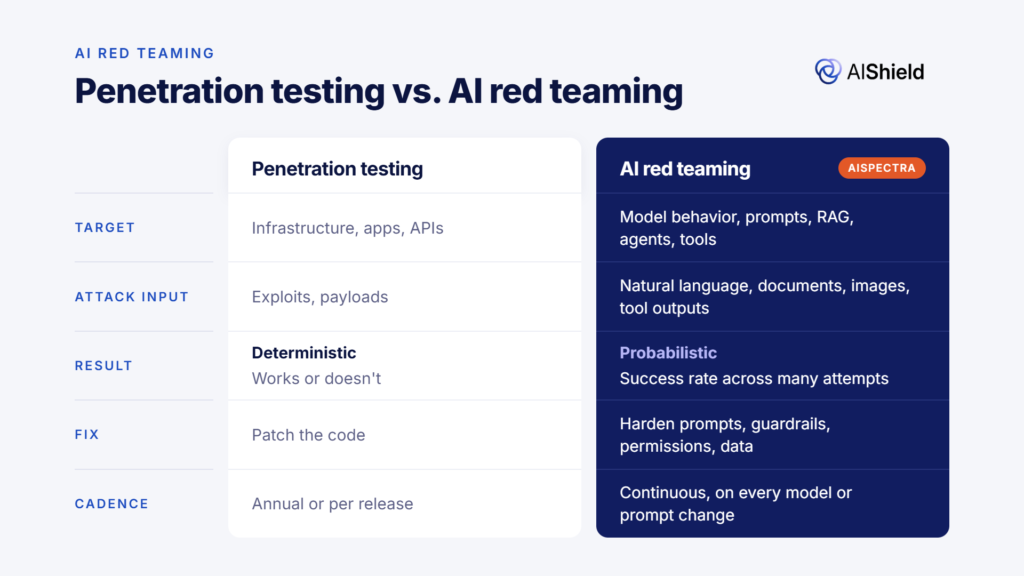
AI red teaming vs penetration testing
Traditional penetration testing targets code, networks and configuration. AI red teaming targets model behavior under pressure, which is probabilistic. The same jailbreak can succeed on one run and fail on the next, so there is no clean patched/unpatched state.
Why map AI red teaming to the OWASP LLM Top 10?
A red team without a scope produces anecdotes. The OWASP Top 10 for LLM Applications gives security, engineering and compliance teams one shared vocabulary for scope and evidence. The current edition is the OWASP Top 10 for LLM Applications 2025 (v2.0), published by the OWASP GenAI Security Project in November 2024. It reflects the shift to RAG and agentic applications, adding System Prompt Leakage and Vector and Embedding Weaknesses and expanding Excessive Agency.
Mapping AI red teaming to the OWASP LLM Top 10 delivers three things:- Coverage you can prove. Every finding lands in a named category, so gaps are visible.
- Audit-ready evidence. OWASP findings slot into the Measure function of the NIST AI Risk Management Framework and into ISO 42001 and EU AI Act controls.
- Real attacker tactics. MITRE ATLAS catalogs real-world attacks on AI systems. Pair each OWASP category with matching ATLAS techniques.
How do you red team each OWASP LLM Top 10 risk?
For each risk: what to attack, a sample scenario, and the pass criteria to hold the system to,
-
LLM01: Prompt Injection, tops the list because the attack surface is the model's own instruction-following.
-
LLM02: Sensitive Information Disclosure, Models leak what they can see: training data, RAG content, session history and secrets in context.
-
LLM03: Supply Chain, Your LLM application inherits risk from every base model, fine-tune, adapter, plugin and library it pulls in.
-
LLM04: Data and Model Poisoning ,Poisoned training, fine-tuning or RAG data can plant backdoors that stay dormant until a trigger phrase appears.
-
LLM05: Improper Output Handling, LLM output is untrusted input to whatever consumes it next: a browser, a SQL engine, a shell, an email client.
-
LLM06: Excessive Agency, Agents with broad tools and permissions turn a successful injection into a real action.
-
LLM07: System Prompt Leakage, System prompts often hold business logic, internal URLs and sometimes credentials.
-
LLM08: Vector and Embedding Weaknesses, RAG pipelines introduce new failure points: retrieval manipulation, embedding inversion and cross-tenant data mixing.
-
LLM09: Misinformation , Confident, wrong answers become a business risk when people act on them.
-
LLM10: Unbounded Consumption , Attackers can exhaust budgets, degrade service or extract the model through high-volume querying.
How does AIShield automate LLM red teaming?
AISpectra Red Teaming is AIShield's automated AI red teaming tool. It tests LLMs, AI agents, tools and MCP servers, RAG pipelines and multi-modal systems against the full OWASP LLM Top 10.
The engine sets attack strategy per system, runs adaptive multi-turn attacks, scores results with a multi-model jury to cut false positives, and feeds every result into a self-improving attack corpus. The output is a kill-chain report, prioritized remediations and evidence mapped to OWASP, NIST AI RMF, ISO 42001, the EU AI Act and MITRE ATLAS. The suite re-tests on every model change.The closed loop with runtime protection
Red teaming finds the weakness; AIGuardian AI Firewall blocks it in production at sub-50ms latency. Both share one platform, so attacks found before deployment harden runtime policy, and attacks seen in production seed new red team scenarios. AIShield was born inside Bosch Research in 2019, co-authored the OWASP Machine Learning Security Top 10 and contributes to MITRE ATLAS.
How often should we red team our LLM applications?
Continuously. Re-run your test suite on every model swap, system prompt change, new tool, new data source and major release. An annual exercise misses most of the changes that reopen the attack surface. Can AI red teaming be fully automated? Automation covers scale: thousands of adaptive, multi-turn attacks per run, repeated on every change. Human experts still add value on business-logic abuse and novel attack chains. The strongest programs use automation as the baseline and humans for depth.Which OWASP LLM risk should we test first? Start with LLM01 Prompt Injection and LLM02 Sensitive Information Disclosure, since most other failures begin with one of them. If your system uses agents or tools, move LLM06 Excessive Agency to the top.
Where should your AI red teaming program start?
Start with one production LLM application and run it against all ten OWASP risks. AISpectra Red Teaming does that in a single automated run and hands you a prioritized fix list.Book a Demo
Share this blog:


Get the best of AIShield delivered straight to your inbox
Subscribe to our newsletter for the latest AI news