What is prompt injection?
Prompt injection is an attack where crafted text makes an LLM follow the attacker's instructions instead of the developer's. It works because a model reads system prompts, user input and retrieved data as one stream of tokens. It has no native way to tell an instruction from data.
Prompt injection is no longer a lab demo. In 2026 it became an operational attack against enterprise AI and the organizations that stop it treat it as a runtime problem, not a prompt-writing problem.
The evidence arrived fast this year. Google reported a 32% relative increase in malicious indirect prompt injection content on the open web between November 2025 and February 2026 (Cloud Security Alliance). Forcepoint and Palo Alto Networks Unit 42 documented live payloads that tried to force $5,000 payments, delete files through coding agents and leak API keys. Microsoft disclosed two critical flaws in its Semantic Kernel agent framework where a single injected prompt could reach host-level code execution (Microsoft Security). Prompt injection still holds the #1 spot in the OWASP Top 10 for LLM applications. What changed is the blast radius. When an LLM could only write text, a successful injection produced an embarrassing answer. When an AI agent can send email, call APIs, query databases and move money, the same injection becomes a breach. This guide explains how to prevent prompt injection in enterprise LLMs and AI agents: what the attack looks like, why your existing stack misses it, the layered controls that work, and how an AI firewall for enterprise enforces them at runtime.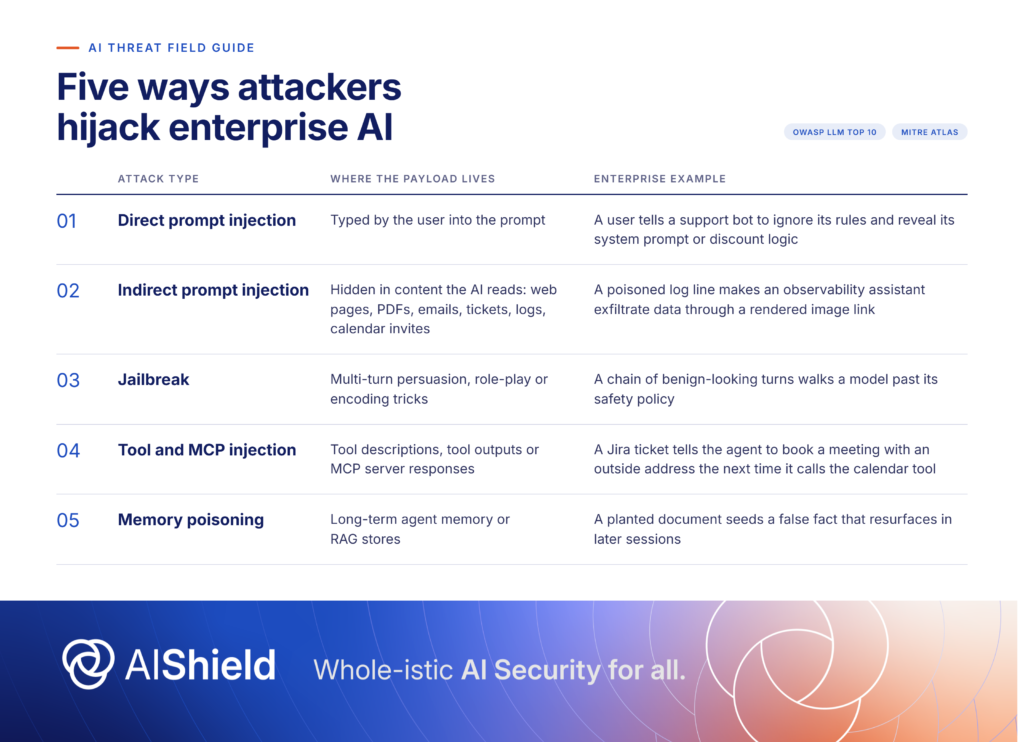
Why indirect prompt injection is the bigger enterprise risk?
Indirect prompt injection does not need a malicious user. The attacker plants instructions in a source your agent will later read, and the agent executes them during normal work. Attackers hide payloads with zero-size fonts, CSS that hides text, HTML comments, data-* attributes and Base64 that decodes at runtime. A human reviewing the page sees nothing. The model sees everything.
Why AI agents raise the stakes
AI agent security is now the core of the problem. Every tool an agent can call — email, code execution, payments, file systems, MCP servers — is a capability an injected instruction can borrow. Model Context Protocol security risks compound this: an MCP server's tool descriptions and outputs flow straight into the model's context, so one compromised server can steer every agent connected to it.
Why your existing security stack misses prompt injection
Your WAF, DLP and SIEM were built to inspect code and known data patterns. Prompt injection is natural language with intent hidden in meaning, so it passes through them untouched. AIShield research estimates that 89% of AI traffic flows past existing security stacks uninspected.
Three gaps explain why:-
Signature matching fails on language. "Ignore previous instructions" has thousands of paraphrases, translations and encodings. A regex blocklist catches the first and misses the rest.
-
System prompts are not a security boundary. Telling a model "never reveal secrets" is a request, not a control. A determined attacker reframes until the model complies.
-
The vulnerability is often not a CVE. In the OWASP GenAI Q1 2026 Exploit Round-up, only one of eight major AI incidents received a CVE identifier (CSA summary). Your vulnerability scanner will not flag what was never assigned an ID.
The consequence for the CISO is direct. A successful injection becomes data exfiltration, fraudulent transactions or unauthorized changes — with no audit trail showing how it happened.
How to prevent prompt injection: 8 layered controls
No single control stops prompt injection. Effective prompt injection attack prevention stacks controls across design, testing and runtime, so an attack that slips past one layer meets the next.
- Inventory every AI asset and data path. List every LLM app, copilot, agent and MCP server, including shadow AI tools employees use in the browser. Map what untrusted data each one reads and which tools and credentials it can invoke. You cannot protect paths you have not found.
- Enforce least privilege for agents. Give each agent the narrowest tool set and scope it needs. Read-only by default. Separate credentials per agent. Several Q1 2026 incidents became severe because agents ran with broad default permissions.
- Separate instructions from data. Use structured prompts that clearly delimit system instructions, user input and retrieved content. Tag every input with its provenance — user, RAG, web, tool output, MCP — so policy can treat untrusted sources differently.
- Inspect inputs at runtime, not just with blocklists. Run every prompt and every piece of ingested content through semantic detection that recognizes injection intent across paraphrases, languages and encodings. Strip hidden text, HTML comments and zero-width characters before content reaches the model.
- Inspect outputs and tool calls. Check model responses for leaked system prompts, PII and secrets. Validate every tool call against policy before it executes. Block exfiltration channels such as Markdown image links to unapproved domains.
- Require human approval for high-impact actions. Payments, deletions, external emails, code commits and permission changes should pause for a human checkpoint. This turns a successful injection into a blocked request instead of an incident.
- Red team continuously. Test LLMs, agents, RAG pipelines and MCP integrations with adaptive, multi-turn attacks — and re-test on every model or prompt change. Static test suites go stale as fast as attackers iterate.
- Log everything to your SIEM. Capture prompts, retrieved context, tool calls, policy decisions and blocks in an immutable audit trail. This gives the SOC visibility and gives auditors evidence mapped to OWASP, NIST AI RMF, ISO 42001 and the EU AI Act.
How AIGuardian AI Firewall stops prompt injection at runtime
AIGuardian is AIShield's AI firewall for enterprise: it sits inline on every AI traffic path and enforces prompt injection policy in real time at sub-50ms latency. It inspects what goes into the model, what comes out, and what the agent tries to do in between.
Coverage across every AI traffic path
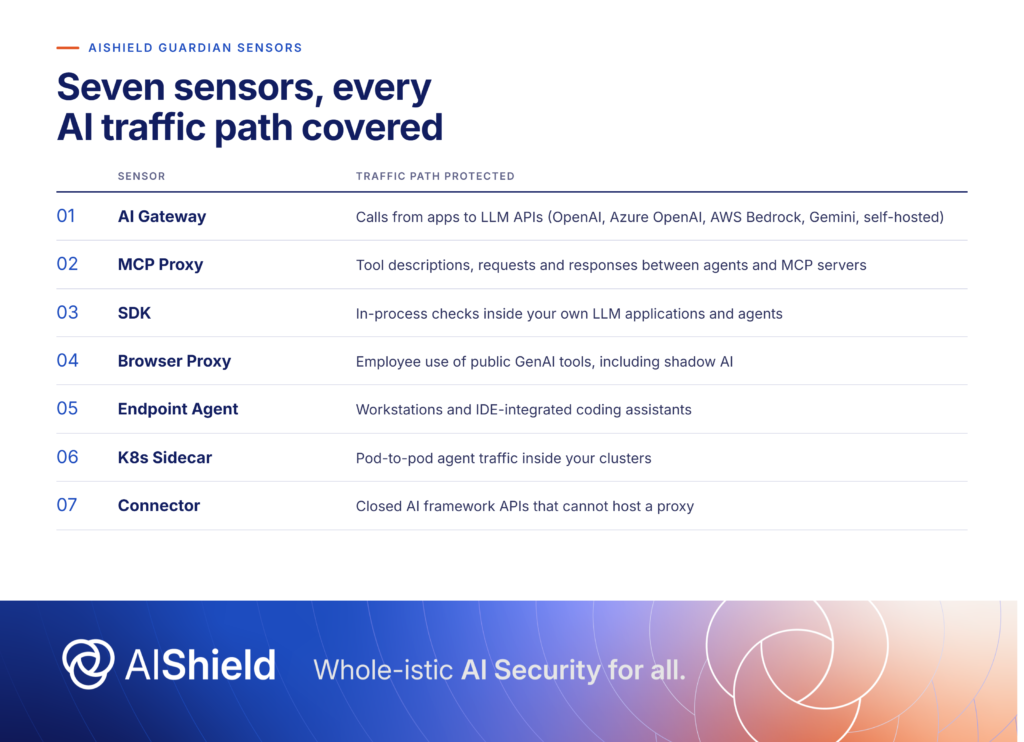
Most LLM firewall protection only sees the API call to the model. Prompt injection also arrives through browsers, IDEs, agent-to-agent calls and MCP traffic. AIGuardian deploys sensors where each path lives:
What AIGuardian enforces
- Direct and indirect prompt injection detection on user prompts and on retrieved content from RAG, web, documents and tool outputs.
- AI jailbreak prevention across multi-turn conversations, not just single messages.
- Guardrails for agentic AI, validating tool calls and MCP actions against policy before they execute.
- AI data leakage prevention with PII redaction for LLMs, secret detection and system-prompt leak blocking on outputs.
- LLM security monitoring with SIEM integration, streaming a full audit trail to Splunk, IBM QRadar or Microsoft Sentinel.
The closed loop with AI red teaming
AIGuardian shares one platform, one schema and one attack corpus with AISpectra Red Team. Attack patterns discovered in pre-production testing harden AIGuardian's runtime policies. Injection attempts blocked in production seed new red team scenarios. Coverage compounds, and mean-time-to-defend shrinks with every cycle. AIGuardian runs as SaaS, private cloud, on-prem, hybrid or air-gapped, so regulated teams keep prompts and data inside their own boundary.Stop prompt injection before it reaches your models
Prompt injection is now a production threat, and it needs production-grade defense. AIGuardian gives your security team LLM runtime protection across every AI traffic path, with the audit trail your regulators expect. Book an AIGuardian demo to see prompt injection blocked live against your own LLM and agent workflows.Share this blog:


Get the best of AIShield delivered straight to your inbox
Subscribe to our newsletter for the latest AI news